
Let’s be completely honest for a moment: buying a budget smartphone used to feel like an exercise in compromise. You’d get decent battery life, but the screen looked washed out. Or you’d get a snappy processor, but the camera snapped photos that looked like they were taken through a foggy window.
But it’s 2026, and the budget smartphone market in India has completely flipped the script.
Today, spending under ₹15,000 doesn’t mean you’re stuck with grainy, muddy photos that you’re embarrassed to post on Instagram. Brands are shrinking flagship-level sensor tech, pairing it with computational AI software, and dropping it right into the sub-15k segment. We are talking about genuine Optical Image Stabilization (OIS), massive 108MP clarity, and raw processing power that can handle tricky lighting.
If you have a strict budget of ₹15,000 and your absolute top priority is camera quality, you’re in the right place. Let’s cut through the marketing jargon, pull back the curtain on megapixel myths, and look at the absolute best camera phones you can buy right now.
Before we dive into the nitty-gritty of how these cameras perform in real life, let’s see how they stack up side-by-side on paper.
| Smartphone | Primary Camera Setup | Key Selfie Camera | Best Camera Feature | Current Price (Approx.) |
|---|---|---|---|---|
| POCO M7 Pro 5G | 50MP Main (with OIS) + 8MP Ultrawide | 16MP | Optical Image Stabilization (OIS) & Steady Video | ₹14,999 |
| Xiaomi Redmi 13 5G | 108MP Main + 2MP Depth | 13MP | High-Res Daylight Detail & 3x In-Sensor Zoom | ₹12,499 |
| Samsung Galaxy M35 5G | 50MP Main + 8MP Ultrawide + 2MP | 13MP | Natural Color Tuning & Super AMOLED Viewfinder | ₹14,499 |
| Moto G64 5G | 50MP Main (with OIS) + 8MP Macro/Ultrawide | 16MP | Clean Software, Close-up Shots, & Low-Light | ₹13,999 |
| Vivo T4x 5G | 50MP Main + 2MP Depth | 16MP | AI Portrait Beautification & Skin Tone Accuracy | ₹13,499 |
If you’ve ever tried to take a video while walking or tried to snap a photo at a dimly lit restaurant, you know how easily a budget camera can fail. The POCO M7 Pro 5G addresses this exact pain point by offering something rare in this price bracket: Optical Image Stabilization (OIS).
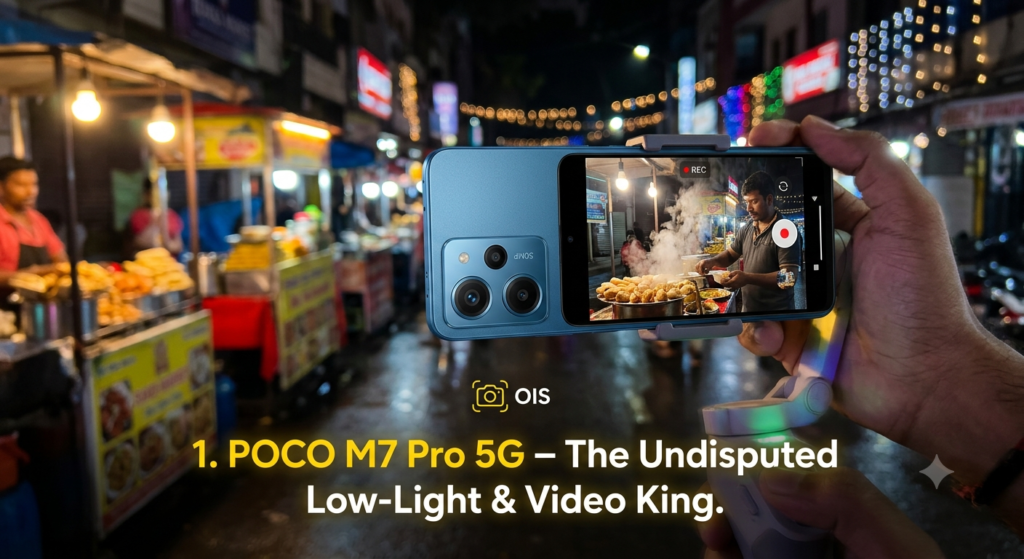
The POCO M7 Pro features a 50MP primary sensor accompanied by an 8MP ultrawide camera. On the front, it sports a crisp 16MP selfie shooter.
OIS is a physical mechanism that moves the camera sensor to counteract the natural shaking of your hands. In real-world testing, this delivers two massive advantages:
Blur-Free Night Shots: Because the camera stays physically stable, it can keep the shutter open a fraction of a second longer to let in more light without blurring the image. Night mode shots here are remarkably clean, with minimal digital noise in the shadows.
Smooth, Stable Video: If you’re a budding content creator making reels or vlogs, the stabilized video output on this phone saves you from shaky, unwatchable footage.
Unlike many competitors who throw away the ultrawide lens to save costs, POCO keeps an 8MP wide-angle lens here. It’s perfect for sweeping landscapes or squeezing your entire friend group into a single frame. Combined with a beautiful AMOLED display that acts as a vibrant, color-accurate viewfinder, it is an incredibly complete camera package.
There is a common phrase in the tech world: “Megapixels aren’t everything.” While that’s generally true, when you pair a massive 108MP sensor with clever software optimization like Xiaomi does, it becomes hard to ignore.
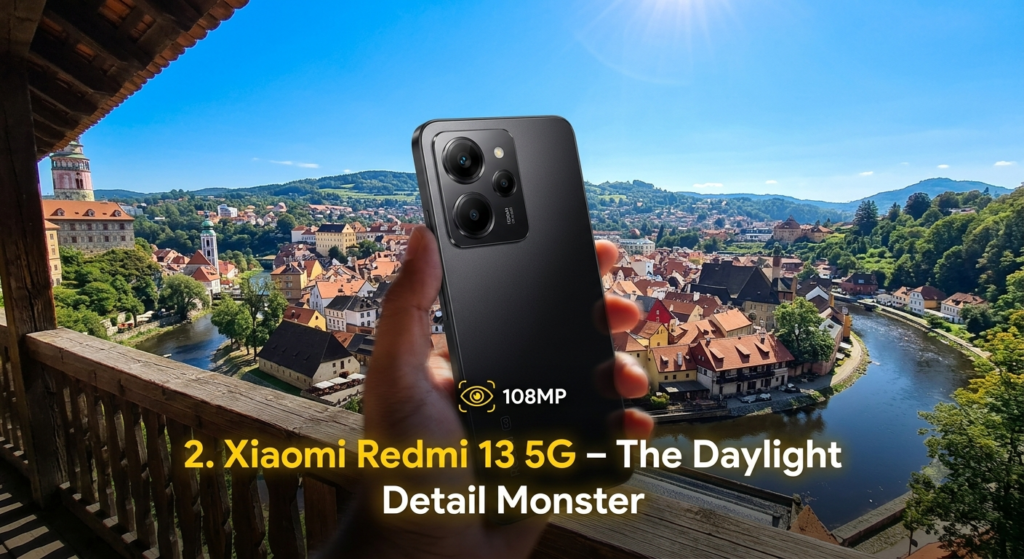
The phone leads with a head-turning 108MP primary camera paired with a basic 2MP depth sensor. Selfies are handled by a 13MP front camera.
The Redmi 13 5G utilizes a process called pixel binning. It essentially groups nine smaller pixels into one giant pixel to capture massive amounts of detail and light.
When you shoot in bright daylight, the clarity is breathtaking. You can take a photo of a distant landscape, zoom in 3x or 4x on the image after clicking it, and still read street signs clearly. It also allows for 3x lossless in-sensor zoom. Instead of digitally cropping and stretching the image (which makes it look pixelated), it crops into the massive 108MP canvas to give you a clean, sharp zoomed-in shot.
The downside? The secondary 2MP lens is essentially a filler. Don’t expect dramatic background blur or crazy macro performance from it. However, if your primary goal is capturing ultra-sharp, high-resolution landscapes and portraits during the day, the primary sensor here punches well above its weight class.
Budget phones often fall into the trap of over-saturating images. They turn skies aggressively blue and grass a blinding neon green to make the photo look “punchy.” If you prefer your photos to look exactly like the real world, the Samsung Galaxy M35 5G is your best bet.
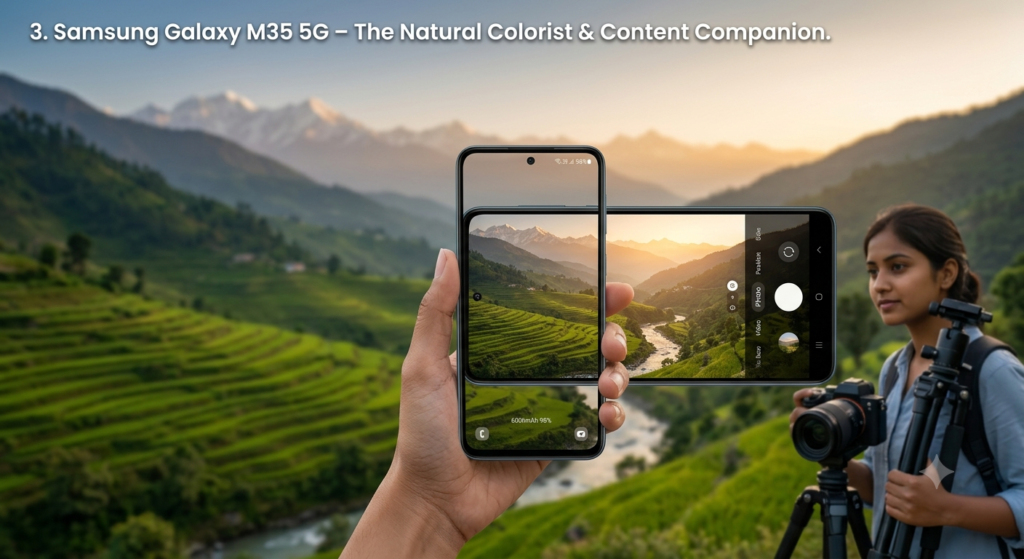
Samsung’s secret sauce has always been its color science and image processing algorithms. The Galaxy M35 handles skin tones with incredible maturity, avoiding the ghostly white or overly aggressive smoothing filters common in budget devices.
The Display Advantage: Viewing your shots on this phone is a treat. It features Samsung’s legendary Super AMOLED display, which offers deep blacks and rich contrast. When you’re framing a shot outside under direct sunlight, this bright screen ensures you can actually see your composition clearly.
A Complete Eco-System: Backed by a massive 6,000mAh battery, you can shoot photos and videos all day without checking your battery percentage. It handles complex high-dynamic-range (HDR) situations—like shooting a subject standing directly in front of a bright window—beautifully, preserving detail in both the dark shadows and the bright sky
Motorola has quietly built a reputation for offering exceptional value without drowning users in bloatware and annoying lock-screen ads. The Moto G64 5G continues this tradition, offering hardware that mirrors premium phones at a fraction of the cost.
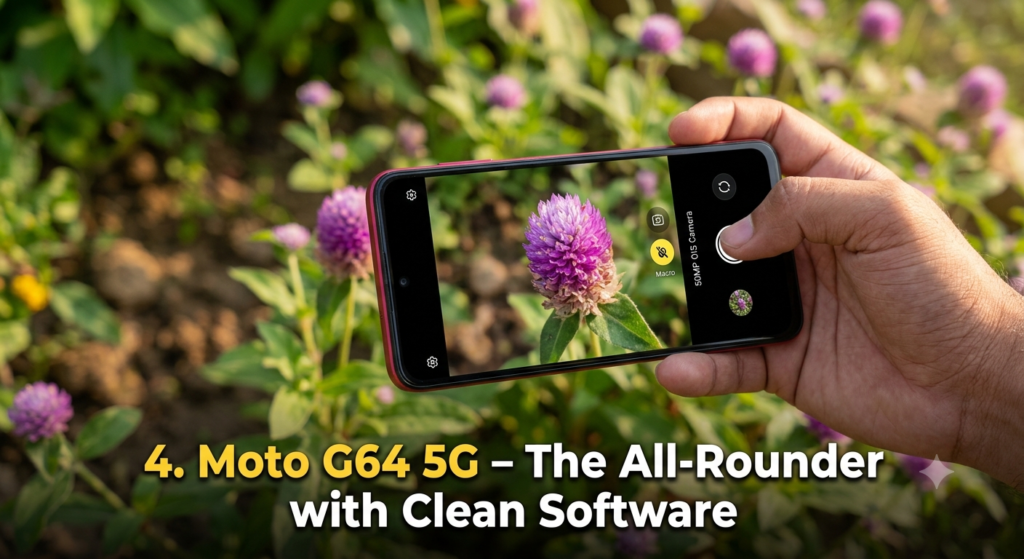
A streamlined dual-camera system consisting of a 50MP primary sensor with OIS and an 8MP dual-purpose lens (which acts as both an ultrawide and a dedicated macro camera). It features a 16MP front camera.
Much like the POCO M7 Pro, the inclusion of OIS here is a game-changer for everyday photography. It completely eliminates minor hand jitters, resulting in consistently sharp images on the first click.
What makes the Moto unique is its smart approach to secondary lenses. Instead of giving you a useless 2MP sensor, Motorola engineered an 8MP lens that pulls double duty. It acts as an ultrawide camera when you want a wider perspective, but can automatically switch to macro mode when you bring the phone inches away from a flower or a textured object.
Combined with Moto’s clean, near-stock Android software, the camera app feels incredibly snappy, loading instantly and firing shots with zero shutter lag.
If your camera roll consists almost entirely of selfies, portraits of friends, and casual daily outfits, the Vivo T4x 5G is tailored specifically for your needs. Vivo has long focused its R&D on human subject photography, and that optimization trickles down beautifully here.
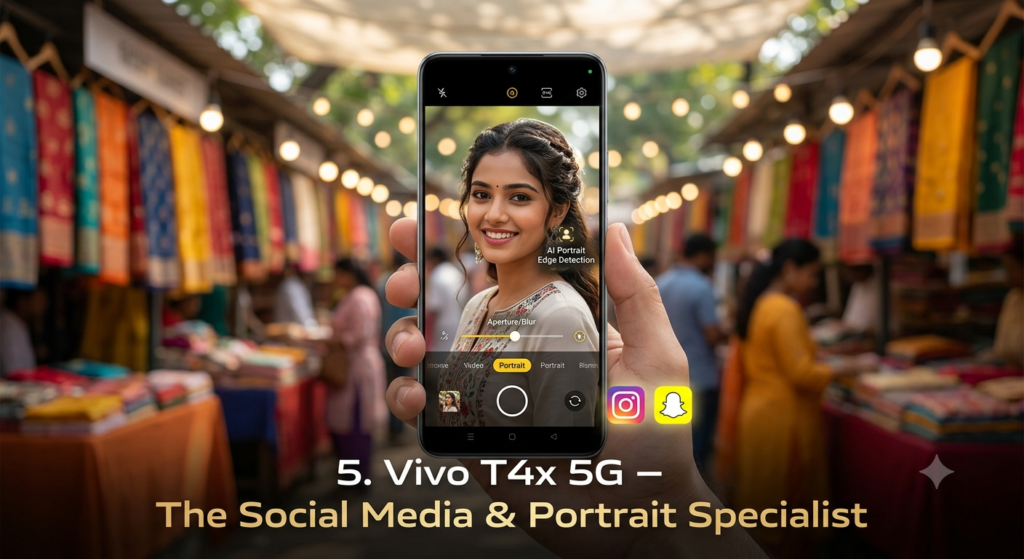
The phone sports a reliable 50MP main camera alongside a 2MP secondary depth sensor. The front camera uses a highly optimized 16MP sensor.
Vivo’s AI processing engine is highly tuned for portrait photography. While some phones struggle to separate a subject’s hair from a blurred background, the Vivo T4x handles edge detection with surprising accuracy.
Flattering Skin Tones: The integrated AI beauty algorithms are excellent at evening out skin blemishes while retaining natural textures like pores and eyebrows, preventing that artificial “plastic wax figure” look.
Social-Media Ready: The colors are bright, well-optimized, and specifically tuned to look great on platforms like Instagram and Snapchat right out of the camera, saving you time on editing filters.
While it lacks an ultrawide lens and misses out on OIS, it makes up for it with sheer processing speed and incredibly reliable daytime portrait performance.
When you browse online storefronts, you are bombarded with numbers: 50MP, 64MP, 108MP. It’s easy to think that a bigger number automatically equals a better camera.
The Reality Check: A 108MP camera on a budget phone doesn’t mean it takes photos that are twice as good as a 50MP camera.
When choosing a camera phone in this budget, look past the main number and consider these three pillars:
If you have a choice between a 108MP camera without OIS and a 50MP camera with OIS, choose the 50MP OIS camera almost every single time. OIS prevents blurry photos, makes video stabilization smooth, and is the single most important factor for usable nighttime photography.
The camera sensor captures light, but the phone’s processor (the brain) turns that light into a JPEG image. A phone with a strong processor—like the Snapdragon or Dimensity chips found in these models—handles noise reduction, color balance, and HDR processing infinitely better than an older or weaker chip.
Many brands advertise a “Triple Camera System,” but when you look closely, it consists of a good 50MP main sensor paired with two useless 2MP lenses (usually labeled as macro and depth sensors). If you love landscape or architecture photography, make sure the phone explicitly lists an Ultrawide lens (usually 8MP) in its spec sheet.
No matter which phone you pick from this list, you can drastically improve your photography game by changing how you shoot. Try these simple adjustments next time you pull out your phone:
Clean Your Lens: It sounds incredibly basic, but our phones live in our pockets and hands, collecting fingerprint grease and lint. Wipe your lens with your shirt before clicking a photo—it instantly removes light streaks and haziness.
Lock Your Focus and Exposure: Tap on your subject’s face on the screen, then slide your finger down slightly to lower the exposure. Budget phones tend to overexpose images; lowering the brightness manually makes your photos look dramatic, contrasty, and cinematic.
Use Daylight to Your Advantage: Budget sensors have physically smaller sensors than premium flagships. Give them light! Position your subject facing a window or the sun rather than having the light source behind them.
Ans: Yes, absolutely. OIS is the most critical feature if you want clear night shots and stable video recording. It physically counteracts slight hand movements, ensuring your camera sensor stays steady to allow crisp low-light photos without artificial blur or camera shake.
Ans: Not necessarily. A higher megapixel count allows you to crop heavily into daytime photos without losing detail. However, actual photo quality depends on the sensor size, software color algorithms, and internal processor. A well-optimized 50MP camera with OIS will often beat a 108MP camera without OIS—especially in indoor and night settings.
Ans: The POCO M7 Pro 5G and the Moto G64 5G are your best options for video creation. Because both models feature physical OIS, they naturally minimize shaky hand jitters while you walk and talk, giving your social media videos a much more stable and professional look.
Ans: In most cases, 2MP macro or depth sensors are “filler lenses” used by brands for marketing purposes to advertise a triple or quad-camera array. If you want true utility out of your extra sensors, look for devices that explicitly feature an 8MP Ultrawide lens (like the Samsung Galaxy M35 5G or POCO M7 Pro 5G) to shoot vast landscapes.
Ans: Most phones in this price segment top out at 1080p video recording at 30fps or 60fps due to chipset constraints. If high-resolution 4K video recording is your ultimate requirement, you may need to stretch your budget slightly above the ₹15,000 threshold into the mid-range segment.
Ans: In bright daylight, the gap is incredibly narrow—budget cameras can capture breathtaking, color-accurate landscape and portrait photos. The major differences between a budget phone and a premium flagship only become obvious in extreme scenarios, such as pitch-black night photography, ultra-fast motion tracking, and high-zoom macro clarity.