
The way people watch television has changed a lot in the past ten years.
The days of relying on cable TV and satellite dishes for live channels and entertainment are gone. Now, internet-based television services are becoming more popular because they offer greater flexibility, better picture quality, and access to content whenever you want.
One of the biggest innovations in this space is IPTV, a technology that delivers television content through an internet connection instead of traditional cable or satellite networks.
But what is IPTV, how does it work, and is it legal to use?
In this complete beginner’s guide, you’ll learn everything you need to know about IPTV, including its meaning, working process, advantages, disadvantages, different types, and how it compares with traditional cable TV.
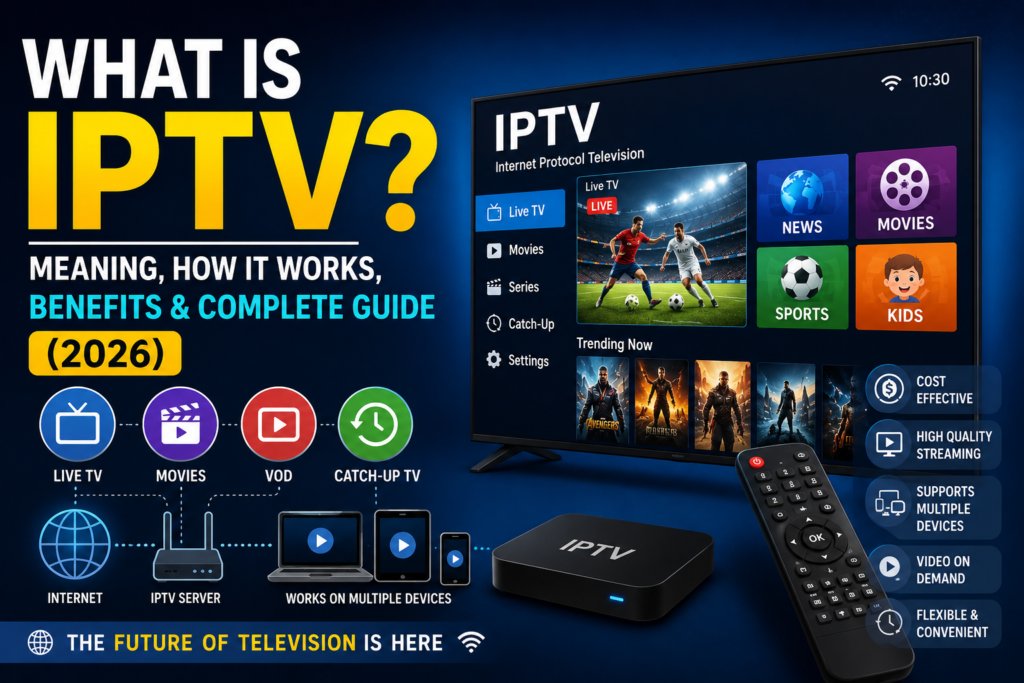
IPTV stands for Internet Protocol Television.
It is a technology that delivers television channels and video content through the internet instead of traditional cable or satellite signals.
Unlike conventional TV broadcasting, IPTV uses Internet Protocol (IP) networks to stream television content directly to your device.
This means you can watch TV on various devices, including:
As long as you have a stable internet connection, IPTV allows you to enjoy television content without relying on a cable connection or satellite dish.
The full form of IPTV is:
Internet Protocol Television
Let’s break down each word:
In simple terms, IPTV means watching television using internet technology.
Traditional television sends signals through satellite or cable networks.
IPTV works differently.
Instead of broadcasting all channels at once, IPTV sends only the content requested by the user over an internet connection.
Here’s a simple step-by-step explanation:
The TV provider stores television content on secure servers.
The user selects a channel or video.
The IPTV server receives the request.
The requested content is compressed and streamed over the internet.
The user’s device receives and plays the content in real time.
This entire process happens within seconds, creating a smooth viewing experience.
There are three major types of IPTV services.
This works similarly to traditional TV, where viewers can watch live news, sports events, entertainment channels, and other broadcasts in real time.
Examples include:
Video on Demand allows users to choose and watch movies or TV shows whenever they want instead of waiting for a scheduled broadcast.
Popular streaming services use a similar on-demand model, allowing viewers to pause, rewind, and continue watching at their convenience.
Time-shifted television lets users watch programs that were broadcast earlier.
For example, if you miss a cricket match or your favorite TV show, you may be able to watch it later through the provider’s catch-up feature.
Modern IPTV services offer several advanced features that make television viewing more convenient.
Some of the most popular features include:
IPTV offers many advantages compared to traditional television services.
Unlike cable TV, IPTV allows users to watch content anytime and almost anywhere with an internet connection.
You don’t need a television to enjoy IPTV.
You can stream content on:
Many IPTV providers support:
provided your internet connection is fast enough.
Unlike traditional TV, IPTV often recommends content based on your viewing history, making it easier to discover movies and shows you’ll enjoy.
Many IPTV platforms include useful features such as:
Since IPTV works over the internet, providers don’t need extensive cable networks or satellite infrastructure to deliver content, making deployment more flexible in many areas.
| Feature | IPTV | Cable TV |
|---|---|---|
| Connection | Internet | Cable |
| Picture Quality | HD, Full HD, 4K | Depends on provider |
| Device Support | Multiple devices | Mostly TV |
| Video on Demand | Yes | Limited |
| Catch-up TV | Available | Rare |
| Installation | Usually simple | Cable setup required |
| Flexibility | High | Moderate |
While IPTV offers several benefits, it also has a few limitations that users should consider before switching from traditional television services.
One of the biggest disadvantages of IPTV is its dependence on the internet.
A slow or unstable connection can lead to buffering, reduced video quality, or interrupted streaming.
For smooth playback, a high-speed broadband connection is recommended.
During peak hours, internet traffic may increase, affecting streaming quality.
If multiple devices are connected to the same network, users may experience occasional lag or buffering.
Although IPTV supports many devices, some services require specific apps or compatible hardware.
Older TVs may need an IPTV-compatible set-top box or streaming device.
Most legitimate IPTV providers require a monthly or yearly subscription.
Pricing varies depending on the number of channels, video quality, and additional features.
Not all IPTV providers offer the same level of service.
Some may provide better streaming quality, customer support, and content libraries than others. Choosing a reputable provider is essential for a reliable viewing experience.
One of the most common questions people ask is, “Is IPTV legal?”
The answer is yes—but it depends on the service you use.
IPTV itself is a legitimate technology used by many licensed television providers and internet service providers.
Many telecom companies and broadcasters use IPTV to deliver live TV channels and on-demand content over the internet.
IPTV is transforming the way people watch television by delivering live channels and on-demand content through the internet instead of traditional cable or satellite connections.
With support for multiple devices, better flexibility, high-quality streaming, and interactive features, IPTV has become a popular choice for modern viewers. However, choosing a licensed IPTV provider and having a stable internet connection are essential for the best viewing experience.
If you’re looking for a smarter and more convenient way to enjoy television, understanding what IPTV is and how it works can help you make an informed decision before choosing a service.
IPTV (Internet Protocol Television) is a technology that delivers television content over an internet connection instead of traditional cable or satellite networks.
The full form of IPTV is Internet Protocol Television.
IPTV streams television content over Internet Protocol (IP) networks. Users simply choose a channel or video, and the content is delivered through the internet in real time.
Yes, IPTV is legal when you use services provided by licensed and authorized content providers.
Yes. IPTV is compatible with smartphones, tablets, Smart TVs, laptops, desktop computers, and streaming devices.
Yes. A stable broadband connection is recommended for smooth HD or 4K streaming without buffering.
IPTV delivers television through the internet, while Cable TV uses traditional cable infrastructure to broadcast channels.
IPTV offers greater flexibility, multi-device support, Video on Demand, and interactive features. However, it depends on a reliable internet connection.